Statement of my problem
In my years of roleplaying, never have I broken into some poor villager’s house and looked for his stash of gold coins. In a video game, sure, but I’ve never even seen that level of murderhobo-ery around a table with real people. Why then do old modules have the life story and full stat blocks of every guy in town, along with a description of where he lives?
The wrong way of doing it
A cool series of blog posts made the gears turn in my head about “town sessions” in the game I’m running with my friends.
The long and short of the article is that urban games are not dungeon crawls. The classic loop doesn’t suit urban environments where time pressure and environmental danger are not present.
This could leave the DM with the question “how in the hell are the players supposed to meet all my cool NPCs?”
As you may suspect, I’m here with a solution.
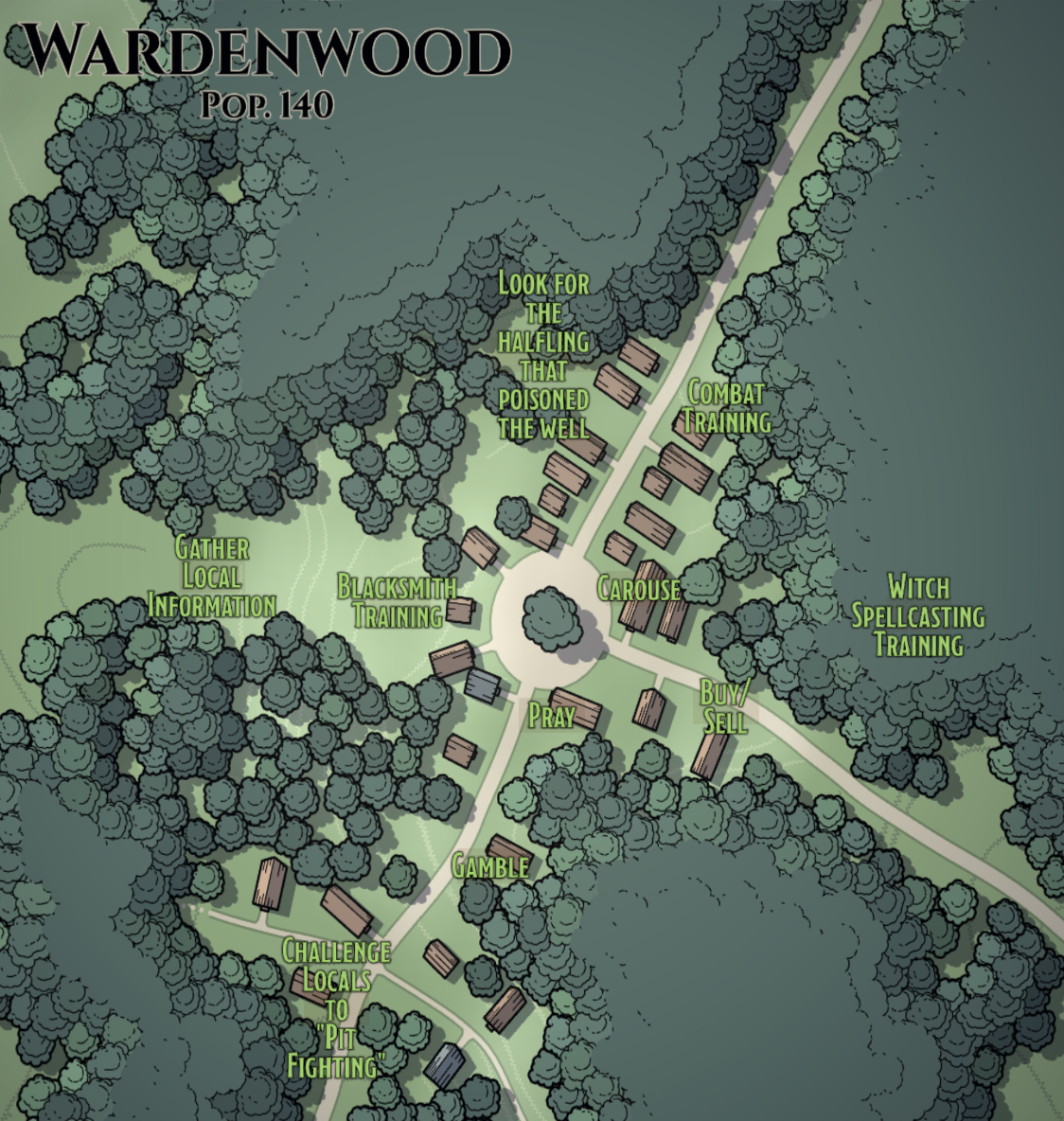
In our next session, the players will enter the town of Wardenwood; they have 3 days before they’re expected elsewhere.
Board game mechanics, in my RPG? It’s more likely than you think.
At the start of the encounter, the players each roll 3d20, and each player will have a token. They’ll take turns placing a dice onto an action on the map, choosing one action to also place their token- for those actions, we will role play the interaction instead of resolving it instantly and mechanically. Basically, I want to run this game in town as a dice/ worker placement game.
After all the dice and tokens are placed, we will go around in initiative order resolving the actions. The player will use the number on the dice they placed at the action (in additional to relevant stat bonuses) to resolve the action.
I’ll present the players with a gazetteer of Wardenwood including important NPC names and obvious facts about the place. Maybe we’ll throw in a bespoke random encounter table to roll on one of the days.
Why though?
TTRPGs always have “decide then roll” mechanics, while modern boardgames often employ “roll then decide” to maximize player agency. By doing towns as dice placement, here we’ll be doing the latter. This way, the players get to make a decision about how to best spend their actions.
This economization and decision space are quite fun in board games. That fun should translate over to role playing without being too mechanical and still leave room for the unexpected, improvisation, and role play.
I’ll run urban encounters like this in both the games I’m DMing. It most likely isn’t “fully cooked” and will require some tinkering. After trying it out at the table a few times, I’ll report back with my results.
 Stuff Cam Wrote