The olden times
I’ve been in and out of love with Dungeons and Dragons since I was first introduced with it allllll the way back around 2004. In love because it’s just so much fun; out of love because I periodically get tired of the old tropes and want to engage in some other types of tabletop gaming: board games, other TTRPG systems, whatever.
It was a mixture of DnD, my first smartphone, and a laser pointer that got me into physics and math (long story, and there may have been some mushrooms involved), and ultimately led me to the life I live now teaching science, going to grad school, and living in Taiwan to improve my Chinese. In short- the game has had no small influence on my life.
Success and Failure, normalcy and depression
On the subject of grad school, I’d been working with a professor on a thesis regarding gravitational waves for about a year, but he became frustrated with the effort and lack of results he perceived on my part. I don’t think the episode was entirely fair, but so it goes. Him telling me to find another project or drop out of physics entirely a few months ago has sucked any desire and pleasure out of this pursuit for me (hopefully temporarily). My sensitive ego has been healing; I’m picking up the pencil again and doing some reading. What I’ve really been excited about recently is DnD.
I built a new computer a few months ago, and have put 70+ hours into Baldur’s Gate III. When I saw a reddit thread looking to start playing in Taipei, I leapt on the chance to make new friends, talk in a funny voice, and roll some dice. We’re playing with the 2024 rules, even though they’re not officially out yet. I’m always eager to try out my favorite class when a new ruleset drops, so of course I’ve rolled up the spooniest bard and am trying to figure out the most impactful way to to spend my turns.
In the 2024 rules, there’s a new bard college- the College of Dance. Obvious choice there, sorry Lore and Valor. I played both of those in BGIII and enjoyed them both, but it’s time for a change. Our game is starting off at third level, so I get the first feature of the dancer bard.
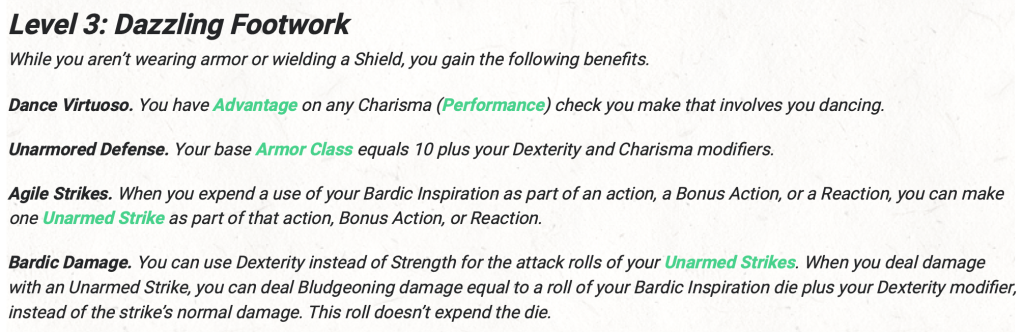
We’re looking at Agile Strikes/ Bardic Damage specifically here. It’s not very strong, but our party doesn’t have another front line fighter, so my Orc bard is a Capoeira-style fighter- a tradition that we all know the orcs from beyond the Spine of the World developed for fighting and story telling. Don’t tell the other members of my party, but I’m just roleplaying Worf from Star Trek TNG. Honor, glory, dance. Today is a good day to groove!
What this post is really about though is that DnD is once again bringing me back to physics, or how through solving a DnD problem, I am fighting my way out of the depression from my bad experience with my previous academic advisor.
Get to the point
I haven’t exactly started the new research project yet, but I am told I’ll be doing MCMC simulations of dark energy, or something like that. I don’t know a ton about cosmology, and I know next to nothing about Monte Carlo simulations, so I am spending time each day learning the basics so I can get into the real work of being creative and solving problems. What better way to practice Monte Carlo than to simulate the outcomes of complicated series of dice rolls?
The fun part
I wanted to see how much damage my bard could do in a turn at level three with an unarmed strike. The answer is not a ton, which isn’t much of a surprise.
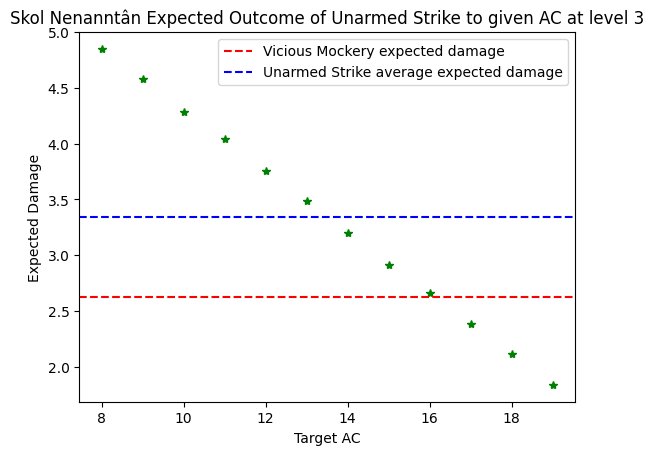
Here we can see the damage I should expect from a given dice roll is a little south of 3.5. Almost one whole point more than a use of Vicious Mockery. I calculated the expected damage from Vicious Mockery much more simply because it cannot critically hit- the average damage on the dice multiplied by 0.75- approximately the chance it will land (it’s a WIS save against my spell DC- 13.)
Pretty cut and dry, right? Why would I use Vicious Mockery ever? It is ranged, which is cool, but it has lower damage output than a simple unarmed attack- but the real purpose of Vicious Mockery is that the target (on fail) has disadvantage on their next attack. Which I’ve calculated lowers the expected damage per roll of an enemy by 2 whole points of damage! Vicious Mockery is saved, and swinging with an unarmed strike should be saved for using Agile Strikes as a bonus action when I buff the Paladin with a Bardic Inspiration.
And for that matter, how does Bardic Inspiration change the Paladin’s attacks?
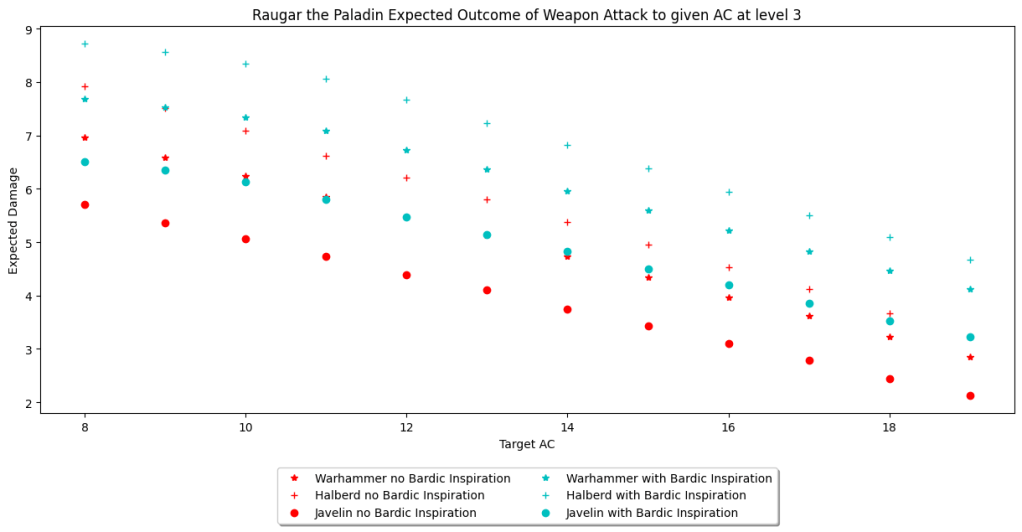
The Paladin has three weapons, a halberd, a Warhammer, and a sack full of throwing javelins (or a jar or whatever way is most convenient to carry them around). This result would suggest the paladin is practically always better off closing the distance and using the halberd.
Now I want to consider how advantage changes the outcome of a given turn. Again, I’m only calculating the expected damage per turn with a given status and weapon combination. If the attack lands, the damage output isn’t affected. There’s a great video here on how advantage and disadvantage change the odds of making a roll.
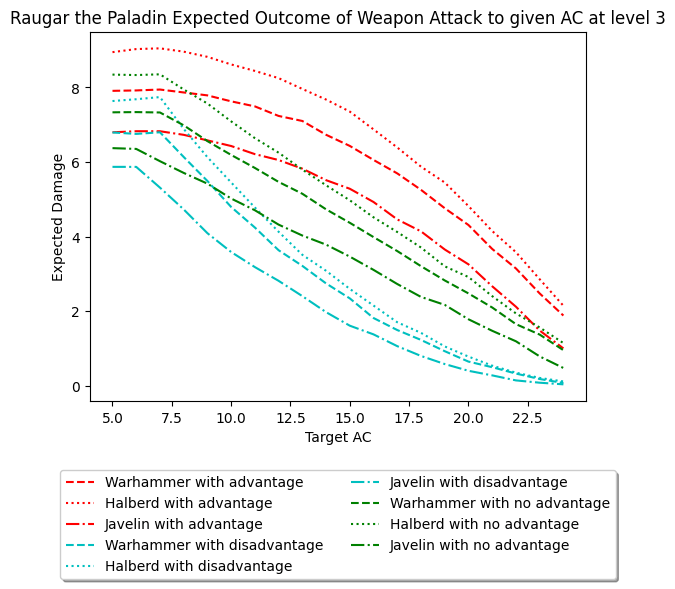
Except in extreme cases, the paladin does more damage per turn than I do. That’s not a problem, doing damage per turn isn’t exactly my role. Thinking of these numbers as representative of a turn in battle, I can expect my turn to be worth about 8 damage- 6 offensive and 2 defensive. I can do about 8 damage and prevent about 2 damage from coming to the party. At level 3, that number can spike a lot higher by casting Hideous Laughter or Dissonant Whispers.
The paladin on the other hand had a turn on our first session where he critically hit and smote his target- I think it totaled up to 47 points of damage. Obviously he can’t keep that up every turn, but it is hard to keep up with that no matter how I slice it.
Conclusion
This was really just a fun exercise to play with simulating random numbers and making graphs. It’s simply a toy- basically high school level programming, but it may affect the way I play the game. At first the simulation was very simple; it calculated if I hit a given AC, if yes do damage, if not, no damage. As I began to consider other elements in combat and how to iterate over more armor classes or with other weapons and weapon types, it grew to have some level of complexity. It’s not the biggest project I’ve ever made (not even for DnD), but it is the most python I’ve written in a couple of years probably. With any luck, I’ll be writing a lot more in the future, and hopefully with more physical meaning.
DnD is about having fun and doing cool stuff, not what statistically is the best choice, but sometimes I think those two things line up.
As the party bard, I chronicled our exploits, and am now working on writing the first tale of Raugar the Mountain. I’ll post it here if it comes out looking alright.
 Stuff Cam Wrote